Forgot your password? Click here

Textus System

Handwritten Text Database

What is the Handwritten Text Database?

The Secondary School Writing Database consists of 5,519 texts written by 662 students in the last four years of Brazilian elementary school. A cross-sectional text sample is available, comprising 2,759 texts produced by 470 students of the sixth, seventh, eighth and ninth school years. In addition, there is a longitudinal sample with 2,616 texts which were produced by 182 students during the four years of secondary school preceding high school.

History

In 2008, when the Database building began, the Brazilian Elementary School System consisted of eight school years named by grade. Through Law No. 11.274, in 2009 an Elementary School System of nine years was introduced, whereby the second cycle, from fifth to eighth grade, now corresponds to the sixth, seventh, eighth and ninth years of elementary school.

In the database system, the grades match as follows:

  • fifth grade = sixth year
  • sixth grade = seventh year
  • seventh grade = eighth year
  • eighth grade = ninth year

The database material has been produced by means of a university extension project called “Development of educational workshops of reading, interpretation and textual production in elementary school” developed by UNESP in partnership with a public school in São Paulo, Brazil. The project has been submitted to and approved by the Research Ethics Committee (CEP) of UNESP. A description of the activities carried out in the extension project, which refer to the collected handwritten texts, has been made by Tenani and Longhin (2014), available at: http://www.seer.ufu.br/index.php/revextensao/article/viewFile/27049/14678

The handwritten texts have been scanned (JPEG image files) and orthographically transcribed according to typing criteria and are available as text files (in DOC format).

Database access

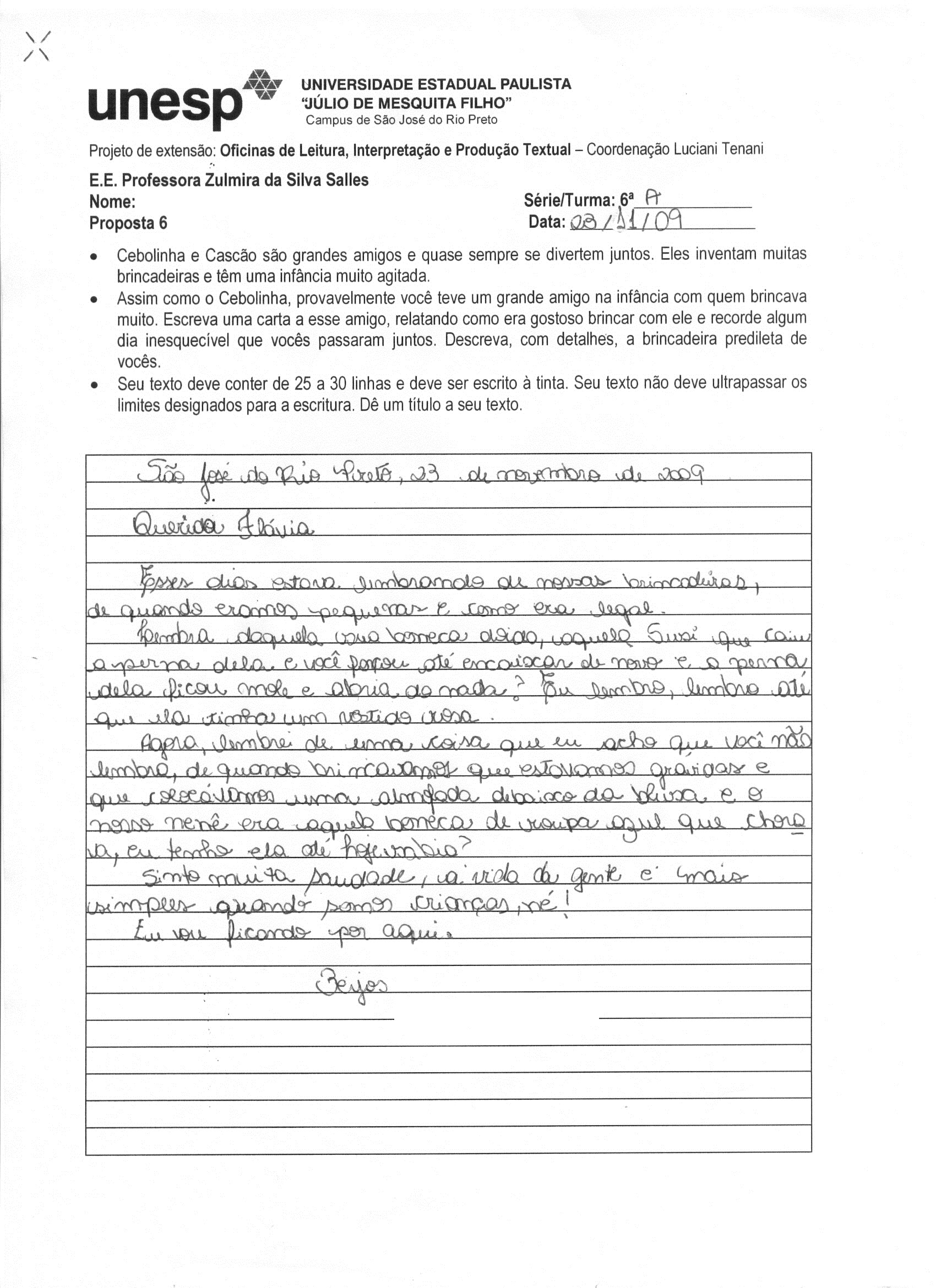
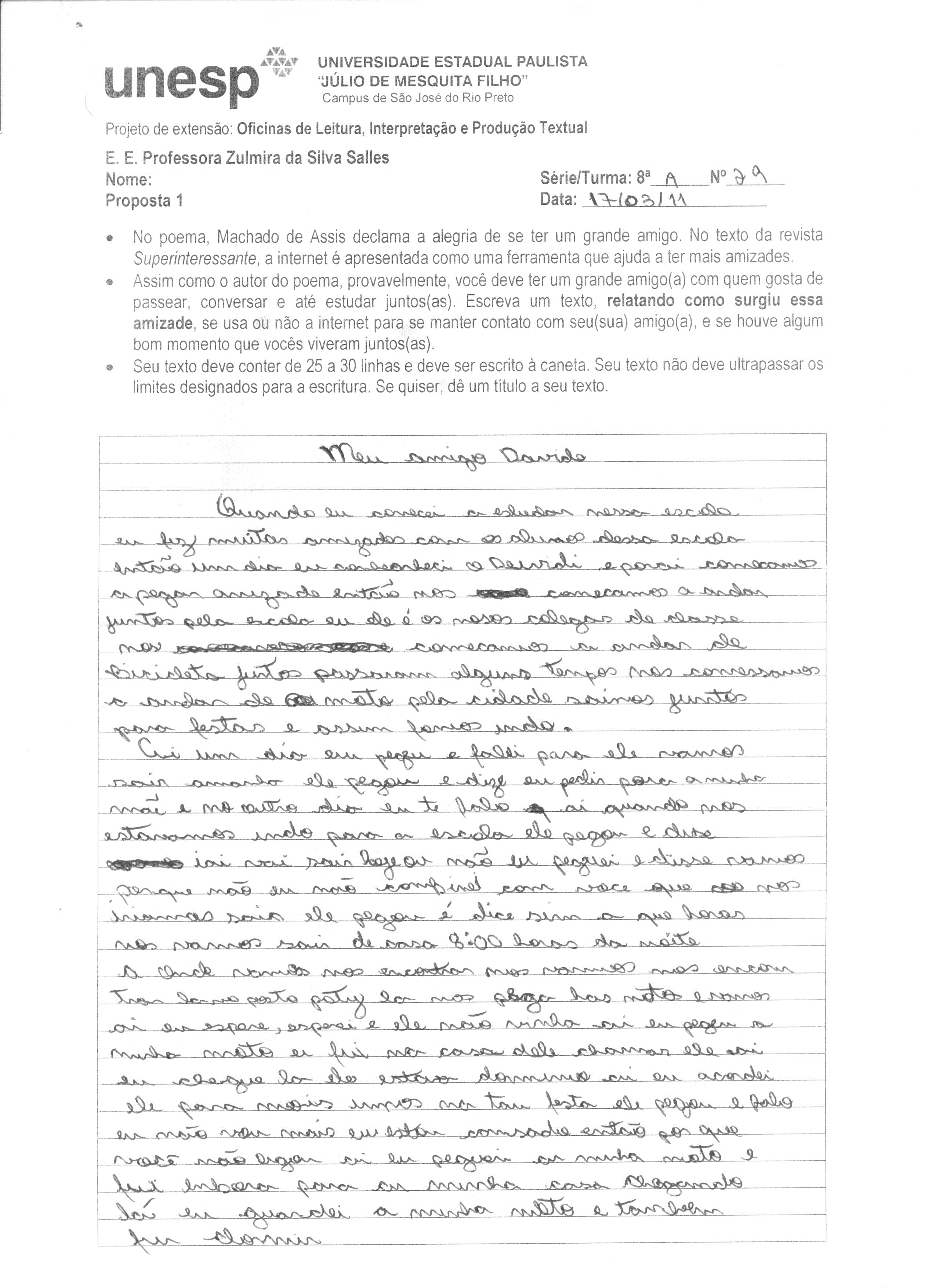
Examples of texts are available as image files [Image1,Image2] and text files [Text1, Text2].

Access to the database texts is free for educators and researchers, but is subject to review via an access permission form. To submit a request for access to the database, fill in the Login form

Research

Since its creation, several researchers have already used the texts of the Secondary School Writing Database.

Different aspects of the texts have been analyzed:

  • unconventional spelling;
  • comma usage;
  • aspects of textualization;
  • characteristics of clause junction in the texts;
  • academic writing practices;
  • digital literacy practices; among others.

These researches can be accessed at: http://www.ibilce.unesp.br/#!/departamentos/estudos-ling-literarios/laboratorio-de-fonetica/banco-de-dados/pesquisas-e-publicacoes/.

Typing Criteria for Handwritten Texts

The handwritten texts have been transcribed observing criteria in order to obtain a digitized version as similar as possible to the original version.
The configuration of the text file is:

  • Paper Size: A4
  • Margins: 3 cm left and right; 2.5 cm top and bottom
  • Font: Arial, 12.
Criteria Example
The text must be copied line by line. The line break (key ) should conform to the original text. The author's name should not appear in the typed text. For the genre "personal letter", insert the first letter of the name that appears at the end. Mas eles fugiam só de dia, porque de
noite era muito perigoso a estrada, mas dessa
ves, Roberto teve uma grandi ideia. (Z08_5A_06F_01)
Nonlinear excerpts or excerpts outside the main text, such as callouts, should be indicated by [ ], in case the WORD text editor features do not allow visual reproduction. Será que eu posso acabar
aqui?
[tchau|] (Z08_5A_31F_01)
The paragraphs should be marked by pressing the key twice (skip a line), in order to leave a blank line between the paragraphs.
Ignore larger spaces between paragraphs.
The start of the paragraph should not be indented. The whole text should be positioned to the left.
Amelia depois de ter caido do cavalo pensou
que de tão rapido que o cavalo tava
ela caiu.

Quando papai chegou com 2 cavalos
um dele e o dela ela pegou seu cavalo
resolvendo voltar para Juvêncio.(Z08_5A_04F_01)
Flag inserted words or phrases using the feature:
\ / If it is inserted above the line

/ \ If it is inserted below the line
com raiva mas
triste pelo amor que tinha \havia/ perdido, mas não
se preucupou pois não adianta chorar pelo leite derra-
mado. Nessa ora seu pai \chico/ entra no quarto (Z08_5A_28F_01)

queria ser uma dona de uma loja que
vende um (rasura)* /monte\ de coisas. (Z08_5B_27F_03)
Punctuation marks should follow the original, without making corrections Eu Perguntava para eles como eles se
chamavam, um deles falou: – Nos somos
etes. – etes? – Isso mesmo. – Eu tenho
uma cor linda não é? – É! (Z08_5A_27F_05)
Texts with drawings should be marked in the bottom right corner by the symbol: E nois voutou a andar de oqui maxine,
fomos para casa, e naquele dia foi o dia mais
felis.

[este é um oqui maxine]

(Z08_5A_05M_03)
Spelling mistakes should be copied. Copy cases of hiposegmentation and hypersegmentation. Type dashes exactly as they appear (_ or -) Eles iam fugir oge anoite, a noiteceu e Roberto
foi arrumar o cavalo, enquanto isso leticia arumava suas roupas. (Z08_5A_06F_01)
The emphasis should match the original A dor da mulher que o marido empurrou do cavalo (Z08_5A_16M_01)
Erasures may be interpreted or not.
If the erasures are legible, the understood word is typed and marked with superscript: emtendi
If the erasures cannot be interpreted, the word erasure is typed inside brackets and an asterisk: (erasure)*
In case punctuation (period, comma) is erased, the erasure is indicated after the punctuation mark by the word (erased) inside parentheses.
If a junction or separation between words is erased, a sharp # is inserted
O Juvêncio começou a bater no cavalo pra ele
correr, poi ele tinha matado a filha sua futura
esposa. (Z08_5A_11F_01)
Logo ali na (rasura)* frente avia uma
pequena cidade, ele desidil (rasura)* passar
a noite lá naquela cidade. (Z08_5A_11F_01)

O : lá primo João vamos mandar MSN,(rasurada) (Z08_5C_21F_04_1)

No dia seguinte, o Pai dela que se chama
Alexandre, con#seguiu pega#lo, (Z08_5A_19M_01)
Those words for which we cannot find a meaning - which are not erasures - should be replaced by an asterisk * eu te encontro no
MSN na segunda-feira as 15:00 hs
o meu login é diegotomé.*@hotmail.com
(Z08_5A_07M_04)
When your computer's line ends but the original text line continues, you should indicate the continuation on the line below by typing a paraghaph indented to the right no futuro quero ser veterinaria e vazer

vestibular

(Z08_5B_27F_03)

Text management system

What is the system?

The TEXTUS text management system was developed to provide quick and easy access to Secondary School Writing Database .

Text search parameters

Each text in the database is identified by coding the following information: school/year_grade/class_student/gender_proposal

Example: Z08_5A_31F_01
Codification:

  • Z School “Z”
  • 08 Year 2008
  • 5 5th grade
  • A Class A
  • 31 Student number
  • F Female
  • 01 Proposal 01

The text search parameters in the system are:

  • Student
  • Student’s sex or gender
  • School
  • Year
  • Grade
  • Class
  • Genre and text typology
  • Writing proposal topic

Responsibility for the system

The organization of the written texts and the design of the text search system were made by PhD. Luciani Tenani, professor at the State University of São Paulo "Julio de Mesquita Filho", Campus of São José do Rio Preto, through project research assistance funded by the São Paulo State Foundation for Research Support, FAPESP (Process 2009/14848-6 and 2013/14546-5).

The system has security features designed to ensure that the data of the individuals who wrote the texts remains completely confidential, so that the students cannot be identified.

The text management system TEXTUS has been developed by GBD/UNESP.

User Guide

The guide goal is to describe in detail the features of the Textus search system and to assist the user. To access the User Guide click here.

Text search parameters

School

The school where the texts were collected is identified by the first letter of its name. E.g.: "Z" indicates a particular school where the texts were produced.

Year

The academic year when the text was written at school is indicated by the last two digits. E.g.: 2008 is indicated by "08".

Grade or Year

The grade or school year is shown by numbers from 1 to 9.

Class

The text is also identified by the class to which the student belonged. Classes are identified with letters which have been established according to the school roll calls. E.g.: “A, B, C, D” and “E”.
The same student may have changed class during a given school year. In such cases, the same student is associated to texts produced in different classes.

Student

Students are identified through codes randomly assigned by the text management system. E.g.: 5, 37, 246.
Following ethical confidentiality criteria to protect the identity of the students who wrote the handwritten texts, the students' names have been removed from the image files and are not included in the text file.

Student’s sex or gender:

The students have been classified as “male" and “female", identified by the letters "M" and "F" respectively.

Writing proposal:

The proposal is identified by "P" followed by numbers from 1 to 7, indicating the chronological order of their assignment. E.g.: “P1”, “P2”.
The 44 proposals of the database are organized in Summary table and can be accessed exactly as they were presented to the students in class.

Writing topic:

The proposal topics have been identified briefly in the system and the set of all topics covered is presented in a Summary table.

Genre and text typology:

The Genre and text typology according to which each textual production can be classified have been set for each school year based on guidelines established by the São Paulo State Curriculum (2008), as presented in the Summary table .
The notions of genre and text typology which supported the development of written production proposals for the database are guided by the proposed São Paulo State Curriculum (2008).

Notions of genre and text typology

Notion of text

The Curriculum Proposal expresses a great concern with the notion of text understood as an enunciation consisting of a fabric with values, tensions and desires of individuals inserted in various social contexts, in a particular historical context (cf. São Paulo State Curriculum Proposal, 2008, p. 46-47).

The curriculum proposal establishes the aim to present texts in diverse communicative situations and suggests a typology for each grade or school year. The definitions for genre and text typology adopted by the São Paulo State Curriculum underlay the development of the writing proposals.

Notion of text genre

"Text Genre" refers to texts found in everyday life which have social and communicative characteristics defined by content, functional properties, style and a typical rendering.

Notion of text typology

"Text Typology" means a type of sequence defined in theory by the linguistic nature of its rendering. The text types include: narration, argumentation, exposition, description, injunction.

Development of proposals

Based on the guidelines of the São Paulo State Curriculum, textual productions with different types of proposals have been developed, as can be seen in the Summary table of writing proposals. The proposals in the database are possibilities for writing texts in class and do not exhaust all possible text developments.

Classification for written production proposals: topic, genre and text typology

Summary Table of Proposals

Year Proposal Topic Genre Typology
2008 - 6th 01 Breakup Short story Narrative
02 Personal story Cordel Report
03 Wishing well Experience report Report
04 Use of the Internet and MSN Personal letter Report
05 Trip to another planet Short story Narrative
06 Trip to Disneyland Short story Narrative
2008 - 7th 01 Breakup Personal letter Report
02 Dangerous or unpleasant experience Experience report Report
03 Beijing Olympic Games Personal letter Report
04 Use of the Internet and MSN Personal letter Report
05 Trip to another planet Personal letter Report
06 A trip to Miami Experience report Report
2008 - 8th 01 Breakup Short story Narrative
02 Cell phone advertisement and rules for its use at school Advertisement Prescriptive
03 A great achievement Short story Narrative
04 Is Internet slang Portuguese or not Argumentative letter Argumentative
05 Planet Earth Personal letter Prescriptive/Report
06 A cruise to Miami Description Description
2008 - 9th 01 Breakup Short letter Narrative
02 Internationalization of the Amazon Opinion article Argumentative
03 Advantages and disadvantages of your school Argumentative letter Argumentative
04 Is Internet slang Portuguese or not Argumentative letter Argumentative
05 Earth's Destruction Opinion article Argumentative
06 A trip with a friend to Miami Short letter Narrative
2009 - 7th 01 Unfulfilled promises Experience report Report
02 Perfection and personal defects Experience report Report
03 Conflict between parents and children Experience report Report
04 Friendship and suffering Experience report Report
05 Teenage sufferings Experience report Report
06 Childhood memories Personal letter Description/Report
07 Fights between friends Personal letter Description/Report
2010 - 8th 01 Benefits of immortality Report about life expectations Description/Report
02 Becoming famous Report about life changes Description/Report
03 Experiencing a misunderstanding Experience report Report
04 Teenage tribes Experience report Report
05 Uncommitted affective engagement Experience report Report
06 Christmas gifts Argumentative letter Argumentative
2011 - 9º 01 Friendship and internet Experience report Report
02 Profile on social networks Survey Description
03 Massacre in Realengo, Brazil Opinion letter Argumentative
04 Adventures in far-off lands Fictional narrative Narrative
05 Internationalization of the Amazon Opinion article Argumentative
06 Smoking ban in public places Opinion article Argumentative
07 Teenager’s concerns about the future Opinion article Argumentative

Database access

Fill out the registration form below. If your application is approved, you will receive password access to the Secondary School Writing Database

Finalidade de uso dos textos do banco *

For a teaching activity
For an undergraduate Scientific Initiation project
For a Master’s project
For a Doctoral project
For a Post-doctoral project
For other purposes, specify in Comments

I declare that I agree to mention the use of the text samples of the Secondary School Writing Database or any information available on this website in any scientific work resulting therefrom.

Reference to the database:
TENANI, Luciani. Banco de Datos de Escrita de la Enseñanza Secundaria. Available at: http://www.convenios.grupogbd.com/redacoes/Login

Reference to the text search system Textus:
TENANI, Luciani Ester; VALÊNCIO, Carlos Roberto; SCARPELINI NETO, Paulo; KAWABATA, Thatiane. BR 51 2015 000035-7, 2014.